A racquet’s grip size is the distance around the handle. It is stamped on the butt cap, and most frames come in a handful of sizes between 4 and 4 3/4 inches. It is one of the few things on a racquet you can’t easily change after you buy it, so it is worth two minutes before you do.
The ruler test
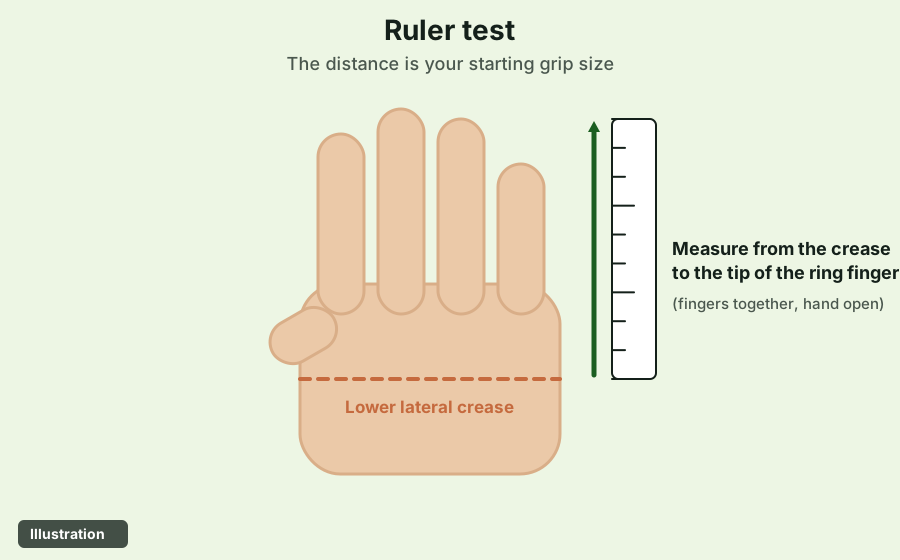
Open your hitting hand with the fingers together. Line a ruler up with the lower lateral crease of your palm, the crease that runs across the middle of the hand, and measure up to the tip of your ring finger. That distance, in inches, is your starting size. Sources describe the crease a little differently, so treat the number as a starting point, not a verdict.
The index-finger test
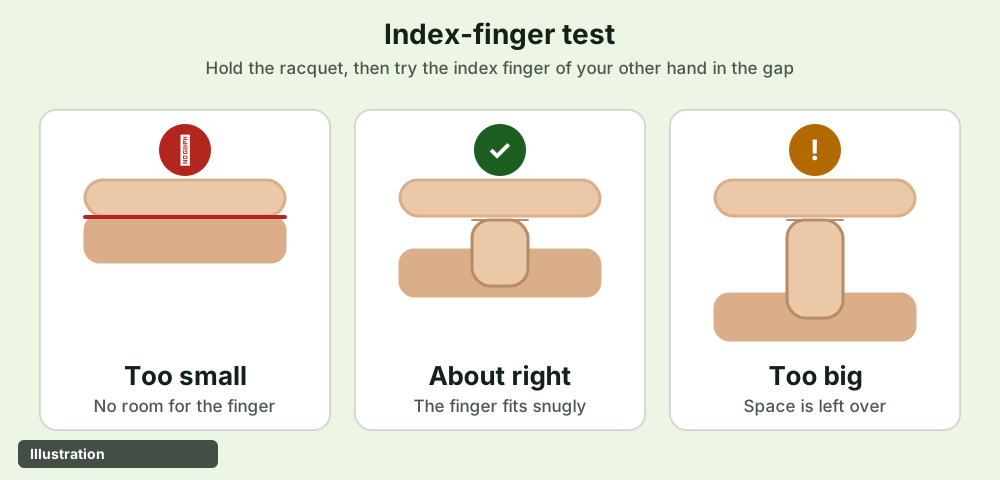
The ruler gets you close. The second check needs a racquet in your hand. Take an eastern forehand grip, with the palm against the same bevel as the string face, and try to slide the index finger of your other hand into the gap between your ring finger and your palm. If it will not fit, the grip is too small. If there is room left over, it is too big. A snug fit is the one you want.
 Illustration
What the sizes are called
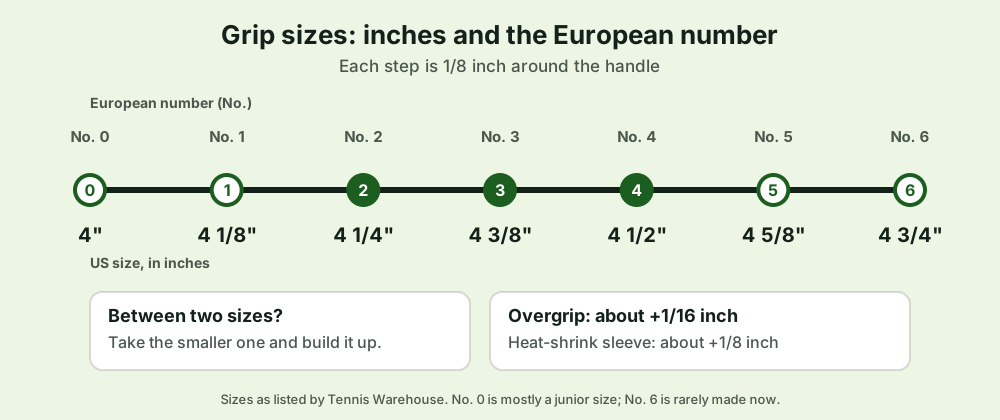
In the United States a size is written in inches, and in Europe it is a single number. The two line up like this: 4 inches is No. 0, 4 1/8 is No. 1, 4 1/4 is No. 2, 4 3/8 is No. 3, 4 1/2 is No. 4, 4 5/8 is No. 5 and 4 3/4 is No. 6. No. 0 is mostly a junior size, and No. 6 is rarely made any more, because the trend has moved to smaller handles.
 Illustration
Why it matters
A grip that is too small makes your hand work harder to stop the racquet twisting, and over a long period that can contribute to tennis elbow. A grip that is too big restricts the wrist snap on the serve, makes changing grips harder and also asks for more muscle strength. Neither is a small thing if you play often.
If you are between two sizes
Go for the smaller one. It is easy to build a handle up and hard to cut one down, and many light, modern racquets can’t be reduced at all. An overgrip adds about 1/16 of an inch, and a heat-shrink sleeve about 1/8 of an inch. Either one adds a little weight, in the range of 7 to 16 grams, and the sources we read agree that a correct fit is worth that.
- Try two sizes if you can, in a shop or on a demo racquet.
- Buy the smaller one and add an overgrip to fine-tune it.
- Replace the grip regularly, since a fresh one gives better control.
What about children?
For juniors the grip matters less than the length of the racquet. Pick the length first, and leave the handle as the second question.
Feel should win over arithmetic. If a size measures right but the racquet feels wrong in your hand, trust the hand.