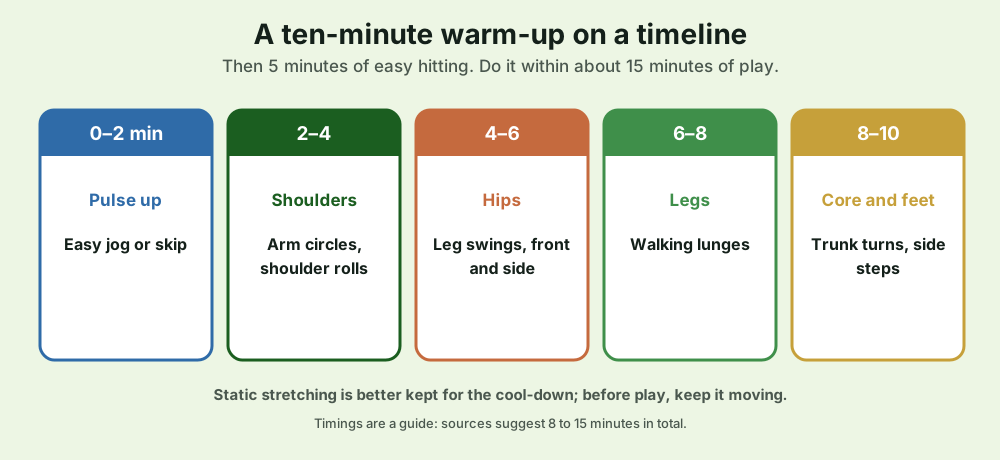
A tennis warm-up has one job: to get the joints moving and the muscles ready for the movements you are about to make. For an hour of play, about ten minutes is enough. For two hours or more, the warm-up itself barely changes. What changes is how you drink and eat while you play.
Move, don’t hold
Before play, dynamic movement is the better choice. Think leg swings instead of touching your toes and arm circles instead of pulling an arm across your chest. Static stretching, where you hold a stretch at its limit, is a poor way to warm up and is better kept for afterwards, as part of the cool-down.
How long
Therapeutic Associates, a physical-therapy group, says a dynamic routine needs about eight to ten minutes. ASICS says coaches generally recommend ten to fifteen minutes before a match and at least five or six if time is short. Tennis Companion adds a timing note: do it right before you play, ideally within fifteen minutes of the first ball.
The six exercises
Start with an easy jog or skip around the court to raise your pulse, then work through these in order.
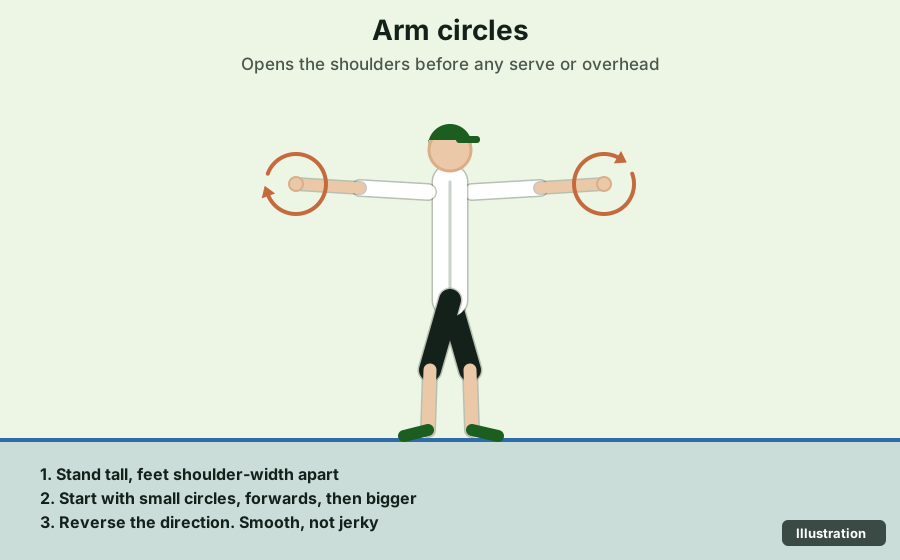
1. Arm circles
Stand tall with your feet shoulder-width apart. Start with small circles forwards, then make them bigger, and then reverse. Keep them smooth. The aim is controlled mobility, not swinging the arms loosely.
 Illustration
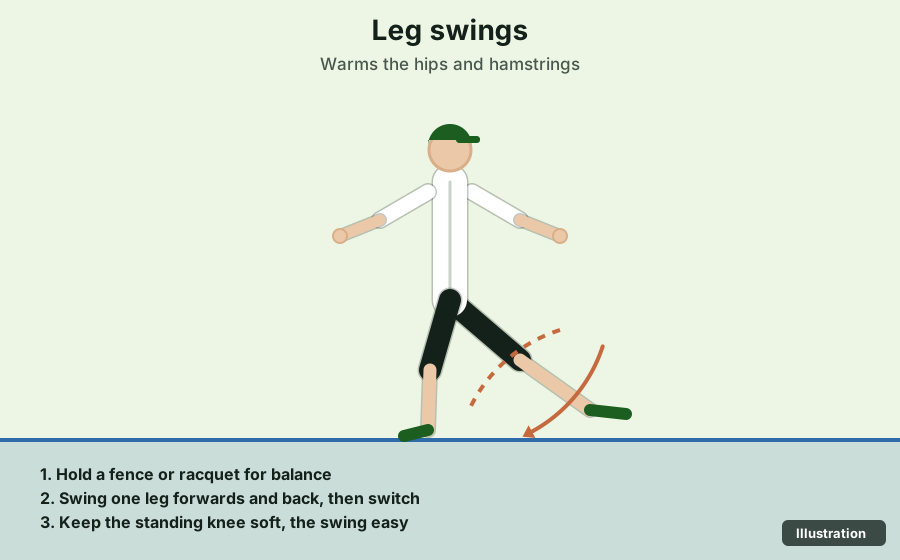
2. Leg swings
Hold a fence or the frame of your racquet for balance and swing one leg forwards and back, then switch. Keep the standing knee soft and let the swing build gently.
 Illustration
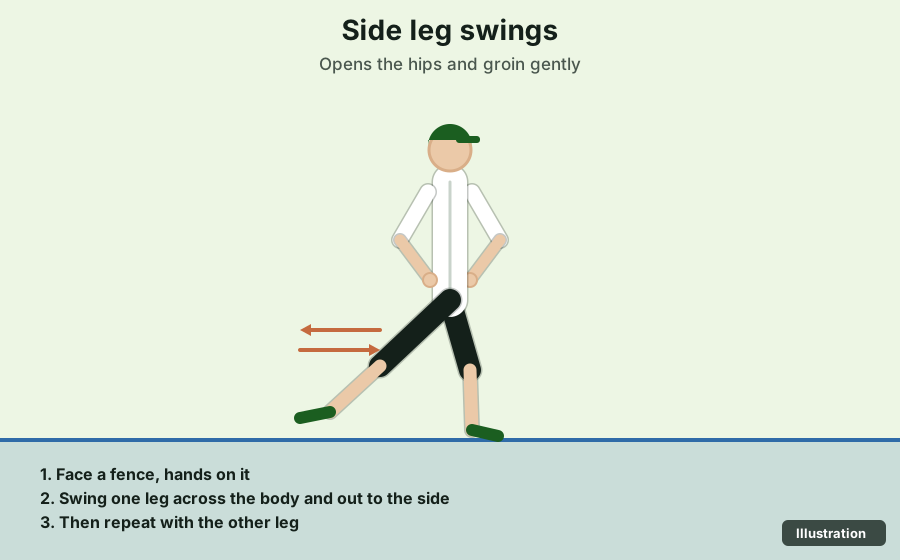
3. Side leg swings
Face a fence with your hands on it, and swing one leg across the body and out to the side, then repeat with the other leg. These swings warm the hips and groin, and the sources agree they should be easy, not forced.
 Illustration
4. Walking lunges
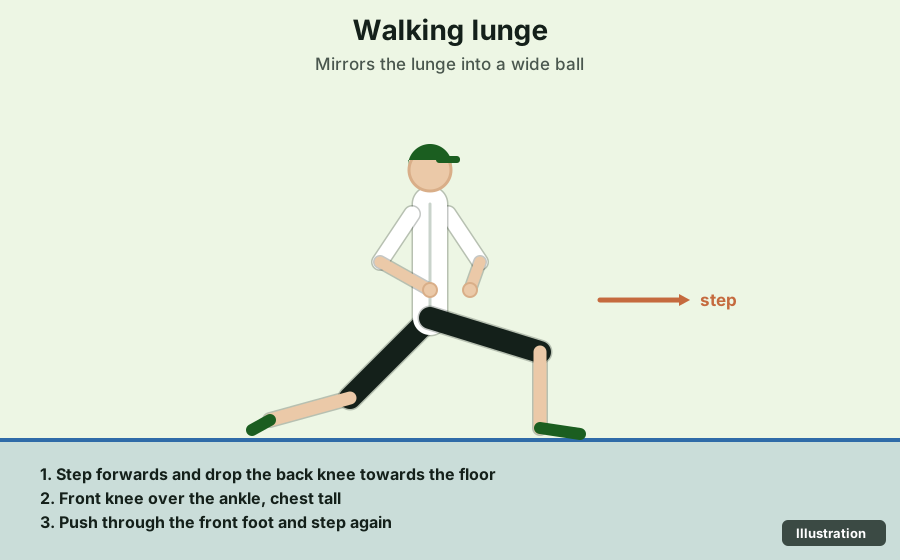
Step forward and drop the back knee towards the floor, with the front knee over the ankle and the chest tall. Push through the front foot to stand and step again. Walking lunges mirror many of the movements in tennis.
 Illustration
5. Trunk rotation with a racquet
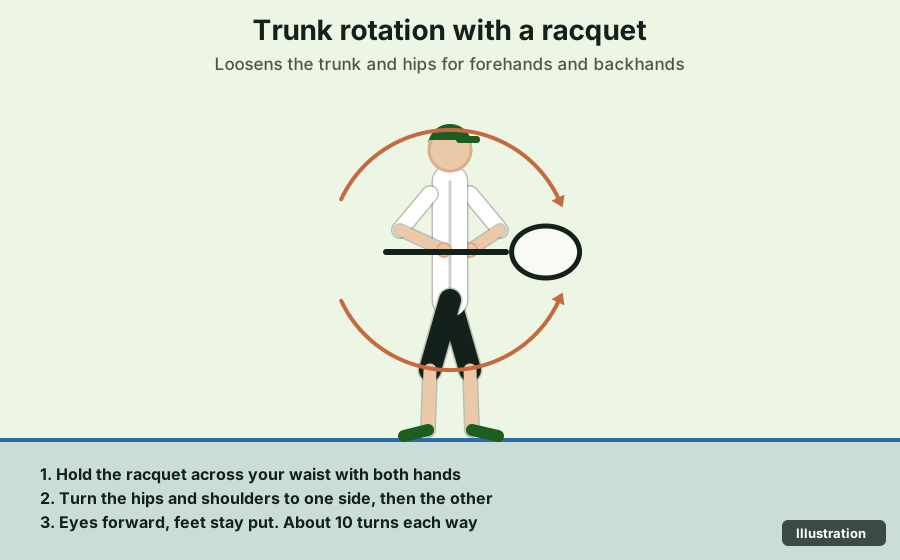
Hold the racquet across your waist with both hands and turn the hips and shoulders to one side, then the other. A club coach on the LTA’s ClubSpark site describes swinging the racquet from side to side this way for about ten repetitions, which loosens the hips, knees and ankles and copies the forehand and backhand.
 Illustration
6. Side steps
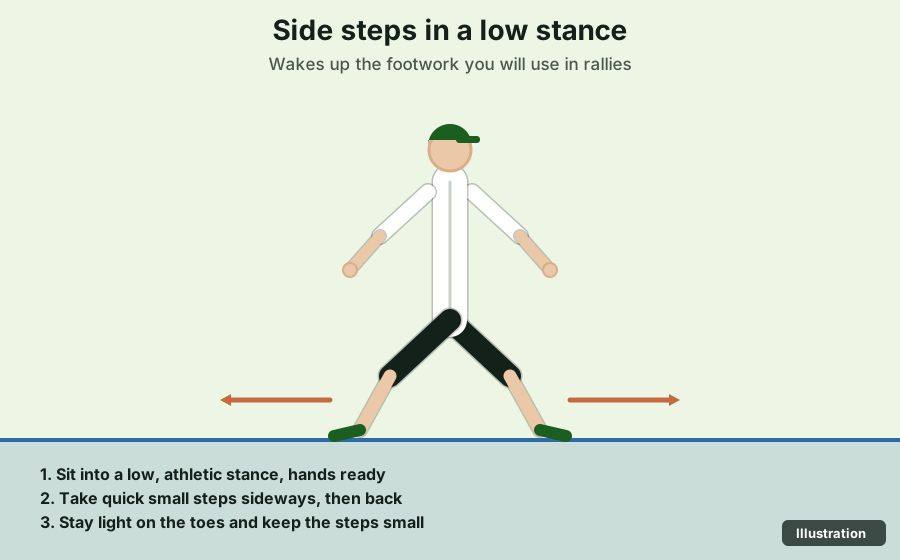
Sit into a low, athletic stance with your hands ready. Take quick, small steps sideways and back. It wakes up the footwork you will use in the first rally.
 Illustration
Then hit
Finish by hitting easy balls, starting with mini tennis, and build the pace and length as the body warms up.
When the session runs two hours or more
The sources we read don’t prescribe a longer warm-up for a longer session. They are clear about what to do on court, though. A review of tennis nutrition in the Journal of Sports Science and Medicine recommends about 200 millilitres of fluid with electrolytes at each change of ends in mild conditions, below 27 degrees Celsius, and at least 400 millilitres when it is hotter. It also recommends 30 to 60 grams of carbohydrate per hour once play goes beyond two hours.
There is some nuance: a small study of three-hour simulated matches found that carbohydrate did not improve performance under its conditions. If you play long sessions, try what works for your stomach in practice, not for the first time in a match.
- Drink at every change of ends, and don’t wait for thirst.
- In a long session, add something with carbohydrate, such as a sports drink or a banana.
- Afterwards, eat carbohydrate soon, ideally within 30 minutes, and a proper meal with protein within two hours.
Cool down
The cool-down is where static stretching belongs. Gentle stretches for the legs, hips and shoulders belong here, once you have stopped playing.
This is general information, not medical advice. If you have an injury or a health condition, ask a doctor or physiotherapist before you change how you warm up or fuel.