This is a sample article by a demo trainer, written to test the trainer features of the site. The grips described are standard, and the sources are linked below.
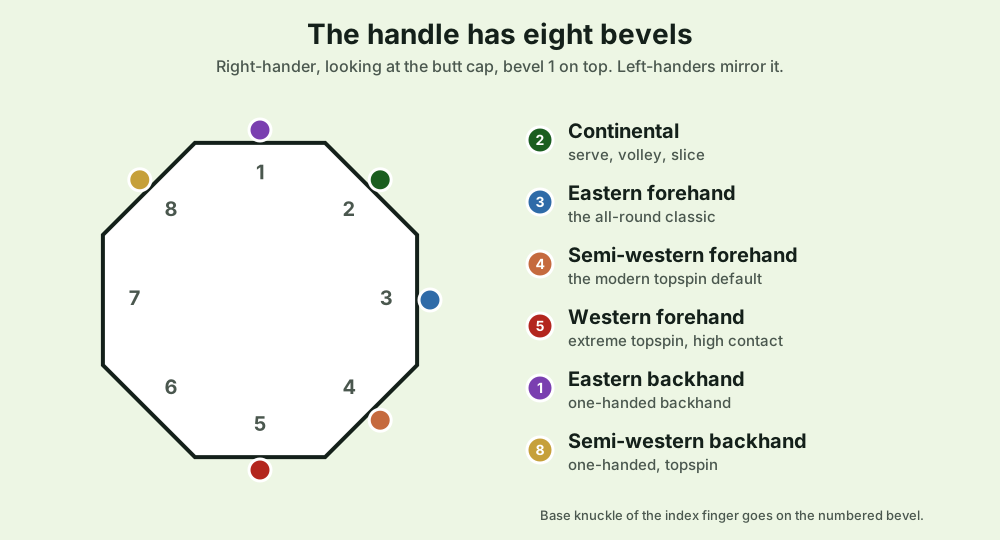
Every grip is defined by where your hand sits on the handle. The handle has eight flat faces, called bevels, numbered 1 to 8. For a right-hander, looking at the butt cap, bevel 1 is on top and the numbers run clockwise. Left-handers mirror it. Two landmarks decide the grip: the base knuckle of the index finger and the heel pad of the palm.
The forehand grips
 Illustration
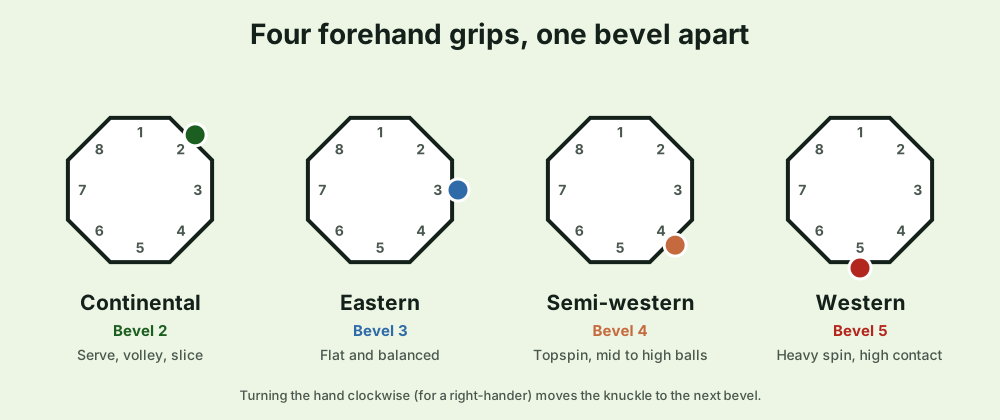
Continental (bevel 2)
Put the base knuckle on bevel 2 and the thumb and forefinger make a V on top of the handle. It is the grip for the serve, the volley, the overhead and the slice, and it is the hitting hand’s grip on a two-handed backhand.
Eastern forehand (bevel 3)
Move the hand one bevel clockwise and you have the eastern forehand, the classic. It is balanced between power, control and spin and it is easy to switch from, which is why it is a common starting point for beginners. It suits low to mid-height balls. Roger Federer’s forehand grip is often described as a modified eastern, between eastern and semi-western.
Semi-western (bevel 4)
One more bevel clockwise. UTR calls it the modern default for topspin and height, and it suits mid-to-high balls and a baseline game built on topspin. On the string bed, the face looks slightly closed in the set position.
Western (bevel 5)
The extreme one: a topspin grip for high contact points. UTR describes it as rare enough among players.
The backhand grips
 Illustration
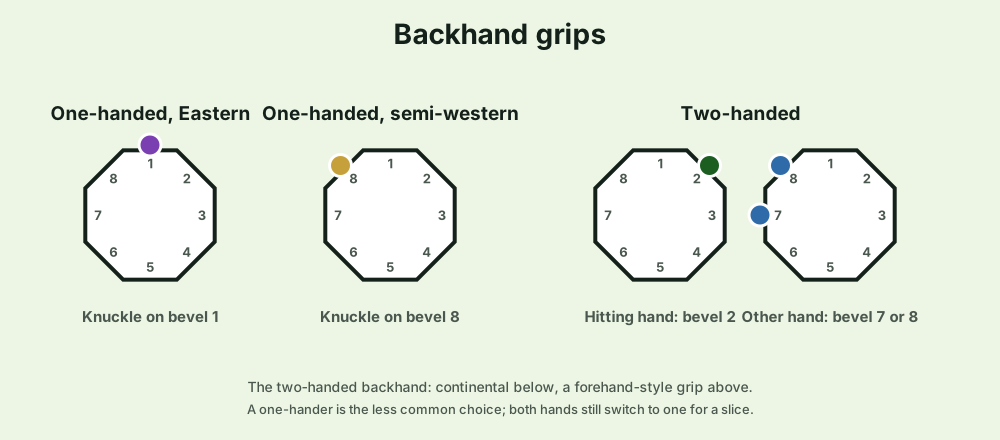
Most players today use two hands. The hitting hand takes a continental grip and the other hand sits above it in an eastern or semi-western forehand grip, which for the second hand is bevel 7 or 8. It is a good choice for players who are not yet strong enough for a one-hander, and it helps on returns, low balls and balls at shoulder height.
A one-handed backhand is the less common choice, with one estimate putting it below one player in ten. The traditional grip is the eastern backhand, with the knuckle on bevel 1, which also makes it easy to move into a volley. A semi-western one-hander, with the knuckle on bevel 8, closes the face and gives more topspin on higher balls, but is harder on low ones. Even two-handers usually hit a slice or a drop shot with one hand.
Which grip suits which game
- All-court and net players: continental and eastern, for quick switches at the net.
- Baseline players who rally with topspin: semi-western.
- Heavy-spin players on slow, high-bouncing courts: semi-western or western.
- Players who like a flat, classic forehand: eastern.
- One-handed backhand players who come forward: eastern backhand.
Courts matter too. Hard and clay courts that kick up reward the semi-western or the western, because they ask the player to hit the ball high.
How to try them
Hit ten balls with an eastern grip and ten with a semi-western and notice the difference in the angle of the face and the height of the contact. Move gradually, one bevel at a time, and let a coach look at it before you change a grip you have used for years.